450 Simple MAC Engine w/ Postproc
450 : Simple MAC Engine w/ Postproc
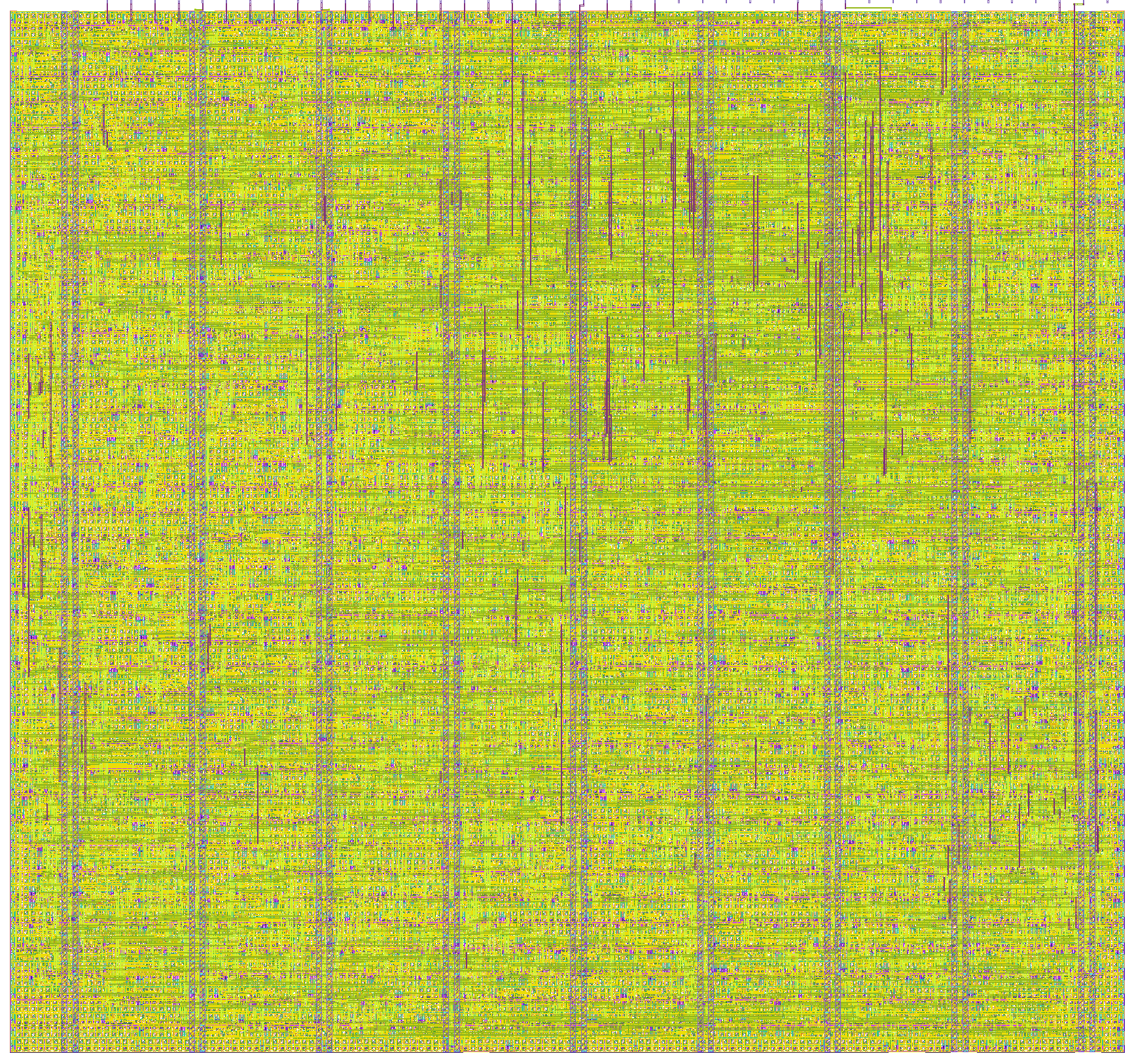
- Author: Luca Goddijn
- Description: Quantized INT8 MAC engine with bias, activation, and quantizer postproc, SPI-controlled
- GitHub repository
- Open in 3D viewer
- Open in Tiny Tapeout Explorer
- Clock: 25000000 Hz
How it works
tt_um_arty3_mac_engine is a standalone signed-INT8 multiply–accumulate
(MAC) engine with an on-chip post-processing pipeline, controlled over a
4-wire SPI slave. It is intended as a co-processor for quantized neural-
network inference on a small MCU: the host streams operands and bias
values over SPI, issues compute commands, and reads back an INT8 result.
Block diagram
flowchart LR
SPI["SPI slave<br/>(uio[3:0])"]
RF["regfile"]
FSM["cmd_fsm"]
PE["conv_pe<br/>(MAC)"]
PP["postproc<br/>bias → act → quant"]
SPI <-->|"rf_addr / rf_wdata<br/>rf_rdata / we / re"| RF
RF <-->|"cmd_valid, cmd_code,<br/>op_a, op_b, status"| FSM
FSM -->|"act_in, wt_in,<br/>acc_in, valid_in"| PE
PE -->|"acc_out"| FSM
PE -->|"acc_out (live + shadow)"| RF
FSM -->|"in_data, in_valid,<br/>out_ready"| PP
PP -->|"out_data, out_valid<br/>(→ RESULT)"| RF
RF -->|"bias, quant_shift,<br/>act_mode"| PP
conv_pe- a single signed INT8 x INT8 → INT32 MAC with a registered accumulator. One MAC perCMD_MAC, no internal storage besides the accumulator.postproc- three-stage pipeline:bias_add→activation(NONE / ReLU / Leaky ReLU, slope = 1/8) →quantize(arithmetic right shift + signed saturation to INT8). Latency: 3 cycles.cmd_fsm- 7-state sequencer (IDLE, MAC, CLR, PP_FEED, PP_WAIT, SOFTRST, DOT4) that owns the handshake toconv_peandpostproc.regfile- 7-bit-addressed byte-wide register file. Holds operands, bias, quantizer/activation configuration, status flags, and the read ports for the accumulator and the result.spi_slave- mode 0 (CPOL=0, CPHA=0), MSB-first. Every transaction is exactly 16 SCLK cycles framed by CS_N.
Register map (summary)
All registers are 8 bits. The top bit of the SPI header is R/W#; the low 7 bits are the address.
| Addr | Name | R/W | Reset | Description |
|---|---|---|---|---|
| 0x00 | STATUS |
RO | 0x01 | {0000, ACC_OVF_STK, RESULT_VALID, BUSY, IDLE} |
| 0x01 | CMD |
WO | - | Writing launches a command (see below) |
| 0x02 | OP_A |
RW | 0x00 | INT8 multiplicand A |
| 0x03 | OP_B |
RW | 0x00 | INT8 multiplicand B |
| 0x04 | BIAS |
RW | 0x00 | INT8 bias added in postproc |
| 0x05 | QUANT_SHIFT |
RW | 0x00 | Arithmetic right shift (0–31) applied in postproc |
| 0x06 | ACT_MODE |
RW | 0x00 | 00=None, 01=ReLU, 10=LeakyReLU(α=1/8) |
| 0x08–0x0B | ACC_B0..B3 |
RO | 0x00 | Accumulator, little-endian. Reading ACC_B0 snapshots the upper bytes into a coherent shadow. |
| 0x0C | RESULT |
RO | 0x00 | INT8 output of the last CMD_POSTPROC. Reading clears RESULT_VALID. |
| 0x10 | FEATURE_ID |
RO | 0xA1 | Engine family + revision |
| 0x12 | OP_A1 |
RW | 0x00 | Lane-1 multiplicand A (CMD_DOT4) |
| 0x13 | OP_B1 |
RW | 0x00 | Lane-1 multiplicand B (CMD_DOT4) |
| 0x14 | OP_A2 |
RW | 0x00 | Lane-2 multiplicand A (CMD_DOT4) |
| 0x15 | OP_B2 |
RW | 0x00 | Lane-2 multiplicand B (CMD_DOT4) |
| 0x16 | OP_A3 |
RW | 0x00 | Lane-3 multiplicand A (CMD_DOT4) |
| 0x17 | OP_B3 |
RW | 0x00 | Lane-3 multiplicand B (CMD_DOT4) |
Commands (write to CMD):
| Code | Mnemonic | Action |
|---|---|---|
| 0x00 | CMD_NOP |
No-op |
| 0x01 | CMD_MAC |
acc ← acc + OP_A * OP_B |
| 0x02 | CMD_CLR_ACC |
acc ← 0 (config registers untouched) |
| 0x03 | CMD_POSTPROC |
Drive acc through bias → activation → quantize; result lands in RESULT |
| 0x04 | CMD_DOT4 |
4-cycle burst MAC: acc ← acc + Σ OP_A{i} * OP_B{i} for i = 0..3 (lane 0 = OP_A/OP_B, lanes 1..3 = OP_A1..3/OP_B1..3) |
| 0xFF | CMD_RESET |
Soft reset: clears acc, RESULT, sticky flags; preserves OP_A/OP_B/BIAS/QUANT_SHIFT/ACT_MODE |
Pin map
ui_in[7:0]   : reserved (tied off internally)
uo_out[0]    : STATUS.IDLE
uo_out[1]    : STATUS.BUSY
uo_out[2]    : STATUS.RESULT_VALID
uo_out[3]    : STATUS.ACC_OVF_STK
uo_out[6:4]  : cmd_fsm state[2:0]
uo_out[7]    : heartbeat (clk / 2^20, ~23.8 Hz at 25 MHz)
uio[0]       : SPI_CS_N (in,  active low)
uio[1]       : SPI_SCLK (in,  mode 0)
uio[2]       : SPI_MOSI (in)
uio[3]       : SPI_MISO (out, driven; held low while CS_N high)
uio[7:4]     : reserved (in)
uio_oe = 8'b0000_1000. MISO is not tri-stated - if you share this
chip's SPI bus with other slaves you must add an external buffer.
Electrical / timing summary
- System clock: nominal 25 MHz (40 ns), max ~50 MHz.
- SPI clock: must be ≤ sysclk/4 (≤ 6.25 MHz at 25 MHz sysclk).
- SPI mode: 0 (CPOL=0, CPHA=0), MSB-first, 8-bit framed, 2 bytes per transaction.
- Reset: active-low asynchronous
rst_n, synchronized internally with a 2-flop async-assert / sync-deassert synchronizer.
For full specifications - SPI bit-level timing, the regfile's read-side
effects, the same-cycle MAC/ACC race definition, the test matrix, and
post-silicon bring-up procedure - see docs/SPEC.md.
How to test
Hardware
You need a SPI master capable of mode-0, MSB-first transactions at
≤ sysclk/4. An MCU dev board (e.g. Raspberry Pi Pico, STM32 Nucleo,
Arduino with a hardware SPI peripheral) is sufficient. A logic analyzer on
uo_out[6:0] is useful for watching the FSM state and status flags
without polling over SPI.
Wire-up:
| Chip pin | Host pin |
|---|---|
uio[0] |
SPI CS (slave-select), driven by host |
uio[1] |
SPI SCLK |
uio[2] |
SPI MOSI |
uio[3] |
SPI MISO (input on the host) |
clk |
host-provided system clock (≤ 50 MHz; 25 MHz nominal) |
rst_n |
host-controlled reset, active low |
Smoke test
- Hold
rst_nlow for at least 3 system clock cycles, then release it. - Read
STATUS(addr0x00). Expected value:0x01(IDLE = 1). - Read
FEATURE_ID(addr0x10). Expected value:0xA1.
If those two reads pass, the SPI slave, regfile, and reset synchronizer are all working.
Functional walkthrough: dot product [3, -2] · [4, 5] with ReLU
Each row below is one full 16-SCLK SPI transaction.
MOSI:  0x81 0x02     ; CMD_CLR_ACC                (acc = 0)
MOSI:  0x82 0x03     ; OP_A = 3
MOSI:  0x83 0x04     ; OP_B = 4
MOSI:  0x81 0x01     ; CMD_MAC                    (acc = 12)
MOSI:  0x82 0xFE     ; OP_A = -2
MOSI:  0x83 0x05     ; OP_B = 5
MOSI:  0x81 0x01     ; CMD_MAC                    (acc = 12 + (-10) = 2)
MOSI:  0x84 0x00     ; BIAS        = 0
MOSI:  0x85 0x00     ; QUANT_SHIFT = 0
MOSI:  0x86 0x01     ; ACT_MODE    = ReLU
MOSI:  0x81 0x03     ; CMD_POSTPROC
MOSI:  0x00 0x00     ; poll STATUS until RESULT_VALID (bit 2) = 1
MOSI:  0x0C 0x00     ; read RESULT  -> MISO returns 0x02
Between commands you can poll STATUS (bit 0 = IDLE) to check that the
FSM has returned to idle. Most commands complete in a handful of system
clocks; the SPI transaction itself is the dominant latency.
Reading the full INT32 accumulator
Always read the four bytes in order ACC_B0, ACC_B1, ACC_B2, ACC_B3.
Reading ACC_B0 snapshots the upper three bytes into a coherent shadow;
out-of-order reads return stale shadow bytes.
Status flags
IDLE(bit 0): FSM is in IDLE andpostprocis empty.BUSY(bit 1): a command is executing.RESULT_VALID(bit 2):CMD_POSTPROChas finished. Cleared by readingRESULT.ACC_OVF_STK(bit 3): a MAC overflowed the INT32 accumulator. Sticky untilCMD_RESETor hard reset.
Simulation
The repository ships a cocotb-based test suite (Icarus Verilog) under test/.
It bit-bangs the SPI interface, exercises every
command, and includes saturation/overflow coverage. From test/:
make
External hardware
None required. The chip is a self-contained SPI slave; any host MCU with
hardware SPI mode 0 is sufficient. A logic analyzer (Saleae, sigrok-
compatible, etc.) on uo_out[6:0] is useful for bring-up but not
mandatory. If sharing the SPI bus with other slaves, add an external
buffer on uio[3] (MISO) because the pad is permanently driven.
Additional links
Project repository: ttgf-mac-engine Spec documentation: SPEC.md
IO
| # | Input | Output | Bidirectional |
|---|---|---|---|
| 0 | unused | STATUS.IDLE | SPI_CS_N (in) |
| 1 | unused | STATUS.BUSY | SPI_SCLK (in) |
| 2 | unused | STATUS.RESULT_VALID | SPI_MOSI (in) |
| 3 | unused | STATUS.ACC_OVF_STK | SPI_MISO (out) |
| 4 | unused | FSM state[0] | reserved (in) |
| 5 | unused | FSM state[1] | reserved (in) |
| 6 | unused | FSM state[2] | reserved (in) |
| 7 | unused | heartbeat (clk/2^20) | reserved (in) |