38 OCP MXFP8 Streaming MAC Unit
38 : OCP MXFP8 Streaming MAC Unit
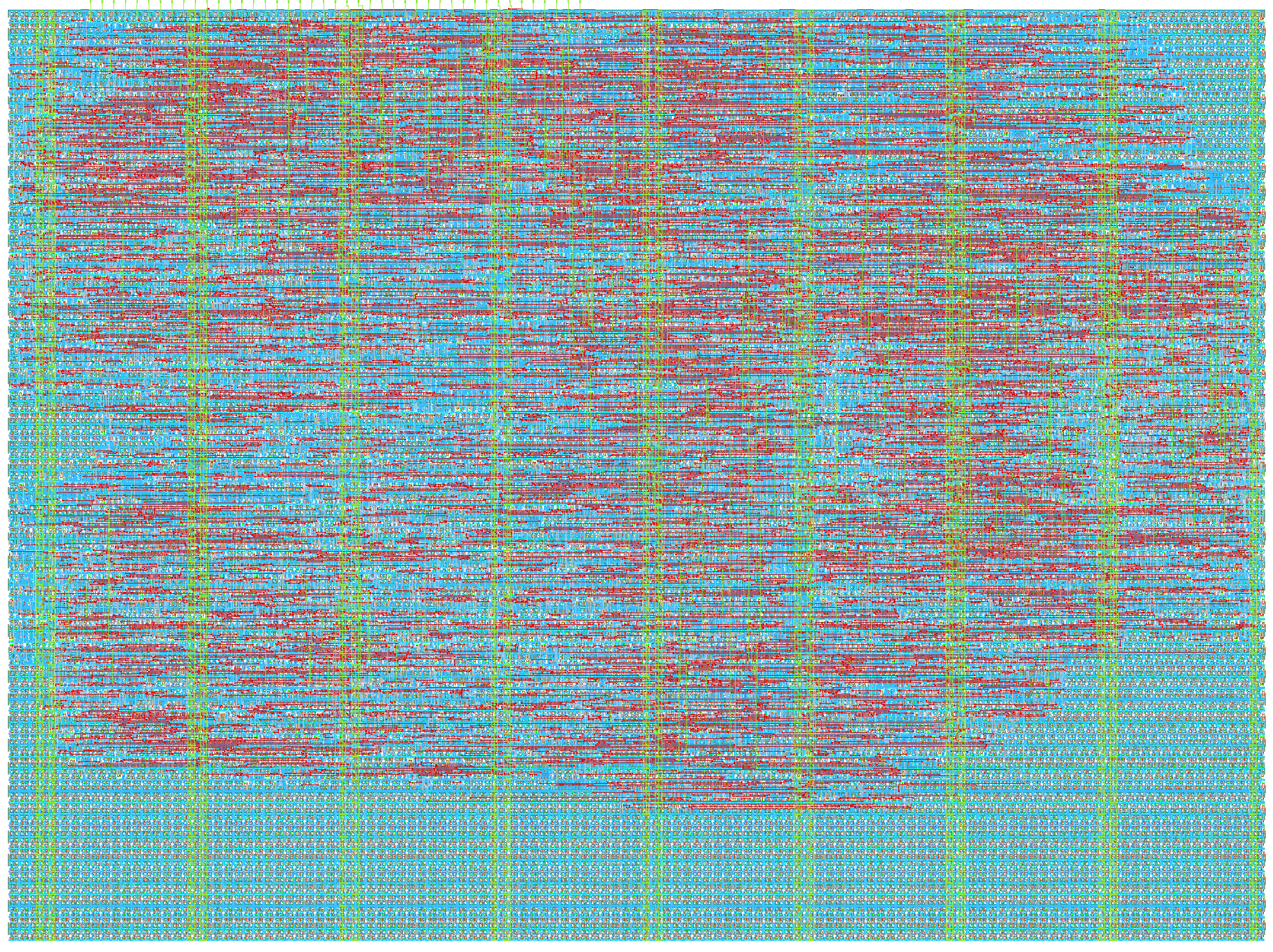
- Author: Olivier Chatelain
- Description: Streaming MAC unit supporting OCP MXFP8 (E4M3/E5M2) with shared scaling
- GitHub repository
- Open in 3D viewer
- Open in Tiny Tapeout Explorer
- Clock: 20000000 Hz
How it works
The OCP MXFP8 Streaming MAC Unit is a high-performance, area-optimized arithmetic core designed for AI inference acceleration. It implements the OpenCompute (OCP) Microscaling Formats (MX) Specification v1.0, supporting a wide range of sub-8-bit floating-point and integer formats with hardware-accelerated shared scaling.
Architectural Overview
The unit is configured in its "Full" edition (2x2 tiles), featuring:
- Dual-Lane Multiplier: Parallel processing of operands with support for Vector Packing (FP4).
- 40-bit Aligner & 32-bit Accumulator: High-precision internal datapath to prevent overflow during long dot-product sequences.
- Shared Scaling (UE8M0): Automatic application of 8-bit exponents ($2^{E-127}$) to element blocks.
- Flexible Rounding: Support for Truncate (TRN), Ceil (CEL), Floor (FLR), and Round-to-Nearest-Even (RNE).
- Mixed Precision: Independent format control for Operand A and Operand B within a single MAC block.
- Logarithmic Multiplier (LNS): Optional area-optimized path using Mitchell's Approximation to reduce multiplier area by >50%.
Streaming Protocol
To maintain a minimal IO footprint (8-bit ports), the unit uses a 41-cycle streaming protocol to process a block of 32 elements ($k=32$).
| Cycle | Input ui_in[7:0] |
Input uio_in[7:0] |
Output uo_out[7:0] |
Description |
|---|---|---|---|---|
| 0 | Metadata 0 | Metadata 1 | 0x00 | IDLE: Load MX+ / Debug or Start Fast Protocol. |
| 1 | Scale A | Format A / BM A | 0x00 | Load Scale A, Format A, and BM Index A. |
| 2 | Scale B | Format B / BM B | 0x00 | Load Scale B, Format B, and BM Index B. |
| 3-34 | Element $A_i$ | Element $B_i$ | 0x00 | Stream 32 pairs of elements.* |
| 35-36 | - | - | 0x00 | Pipeline flush & final scaling. |
| 37-40 | - | - | Result [31:0] | Serialized 32-bit result (MSB first). |
*Note: In Packed Mode (uio_in[6]=1 in Cycle 0), the STREAM phase is reduced to 16 cycles (Cycles 3-18).
Register Layouts
The unit captures configuration and scaling data during the first three cycles of the protocol.
Cycle 0: Metadata 0 (ui_in)

- Short Protocol (
[7]): 1: Reuse previous scales/formats; immediately jump to Cycle 3. - Debug En (
[6]): 1: Enable internal probing and metadata echo at the end of the block. - Loopback En (
[5]): 1: Direct input-to-output mapping for physical connectivity testing. - LNS Mode (
[4:3]):0: Normal (Exact IEEE-like multiplication).1: LNS (Logarithmic Number System using Mitchell's Approximation).2: Hybrid (Standard for Block Max elements, LNS for all others).
- NBM Offset A (
[2:0]): (Standard Start only) Exponent offset for non-Block Max elements in Operand A (MX++).
Cycle 0: Metadata 1 (uio_in)

- MX+ Enable (
[7]): 1: Enable OCP MX+ extensions (Repurposed exponents and Block Max tracking). - Packed Mode (
[6]): 1: Enable Vector Packing for 4-bit formats (2 elements per byte, Cycles 3-18). - Overflow Mode (
[5]): 0: SAT (Saturate to Max/Min), 1: WRAP (Modulo arithmetic). - Rounding Mode (
[4:3]):0: TRN (Truncate/Towards Zero).1: CEL (Ceil/Towards $+\infty$).2: FLR (Floor/Towards $-\infty$).3: RNE (Round-to-Nearest-Ties-to-Even).
- NBM Offset B / Format A/B (
[2:0]):- Standard Start: NBM Offset B (Exponent offset for Operand B).
- Short Protocol: Combined Format A & B selection.
Cycle 1: Scale A (ui_in) & Config A (uio_in)
Scale A (ui_in[7:0]):

- Shared Scale A: 8-bit unsigned biased exponent (UE8M0, Bias 127) applied to all elements in Operand A.
Config A (uio_in[7:0]):

- BM Index A (
[7:3]): The index (0-31) of the "Block Max" element in Operand A (used in MX+ mode). - Format A (
[2:0]):0: E4M3,1: E5M2,2: E3M2,3: E2M3,4: E2M1,5: INT8,6: INT8_SYM.
Cycle 2: Scale B (ui_in) & Config B (uio_in)
Scale B (ui_in[7:0]):

- Shared Scale B: 8-bit unsigned biased exponent (UE8M0, Bias 127) applied to all elements in Operand B.
Config B (uio_in[7:0]):

- BM Index B (
[7:3]): The index (0-31) of the "Block Max" element in Operand B. - Format B (
[2:0]): Independent format for Operand B (Enabled ifSUPPORT_MIXED_PRECISION=1).
How to test
Basic Verification
- Reset: Pulse
rst_nlow, then setenahigh. - Configuration:
- Cycle 0: Provide
0x00on bothui_inanduio_infor standard E4M3 mode. - Cycle 1: Provide
0x7F(1.0 scale) onui_inand0x00(E4M3) onuio_in. - Cycle 2: Provide
0x7F(1.0 scale) onui_inand0x00(E4M3) onuio_in.
- Cycle 0: Provide
- Data Streaming:
- Cycles 3-34: Provide 32 pairs of values. E.g.,
0x38(1.0 in E4M3) on both ports.
- Cycles 3-34: Provide 32 pairs of values. E.g.,
- Result:
- Cycles 35-36: Wait for internal processing.
- Cycles 37-40: Read the 32-bit signed fixed-point result on
uo_out. - For 32 pairs of $1.0 \times 1.0$, the result should be
0x00002000(representing 32.0 in the system's 8-bit fractional format).
Advanced Modes
- Short Protocol: Set
ui_in[7]=1in Cycle 0 to bypass scale loading. Useful for weight-stationary kernels where scales and formats remain constant across blocks. - Vector Packing: Set
uio_in[6]=1in Cycle 0. Stream two 4-bit elements per byte (High nibble = Element $i+1$, Low nibble = Element $i$).
External hardware
- Tiny Tapeout DevKit: The easiest way to interface with the chip. Use the provided MicroPython driver (
test/TT_MAC_RUN.PY) for quick prototyping. - Sipeed Tang Nano 4K: For high-speed testing, a dedicated FPGA bitstream and Cortex-M3 testbench are provided in the repository.
IO
| Port | Name | Description |
|---|---|---|
ui_in[7:0] |
Operand A / Scale A | Elements $A_i$ or Scale $X_A$. |
uio_in[7:0] |
Operand B / Scale B | Elements $B_i$ or Scale $X_B$. |
uo_out[7:0] |
Result Out | Serialized 32-bit dot product result. |
clk |
Clock | System clock (Target: 20MHz). |
rst_n |
Reset | Active-low asynchronous reset. |
ena |
Enable | Clock enable. |
Appendix: OCP MX+ Mathematics
The OCP MX+ extension optimizes quantization by preserving high-precision "outliers" (Block Max elements) while maintaining a low bit-width for the rest of the block.
1. Base OCP MX Mathematics (Standard)
For a block of $k$ elements, the value of an element $A_i$ is given by: $V(A_i) = S \cdot M_i \cdot 2^{X_A - 127}$ Where:
- $S$: Sign bit ($\pm 1$).
- $M_i$: Mantissa (significand), including an implicit leading bit for subnormals.
- $X_A$: Shared 8-bit scale (UE8M0).
- $E_i$: Individual element exponent (for FP8/FP6/FP4 formats).
2. OCP MX+ (Extended Mantissa)
When MX+ Enable is set, the Block Max (BM) element—identified by BM Index—repurposes its exponent bits as additional mantissa.
Normal Element ($i \neq BM$): Decoded as standard MXFP (e.g., E4M3).
Block Max Element ($i = BM$):
- Exponent: Fixed to $E_{max}$ for the selected format.
- Mantissa: The original exponent bits are appended to the mantissa field.
- Benefit: For FP4 (E2M1), the mantissa grows from 1 bit to 3 bits ($1 + 2$), reducing quantization error for the most critical value by up to 10x.
3. OCP MX++ (Decoupled Shared Scaling)
MX++ allows "Non-Block Max" (NBM) elements to use a finer quantization grid than the BM element by applying a secondary exponent offset.
$V(A_{i \neq BM}) = S \cdot M_i \cdot 2^{(X_A - 127) - NBM_Offset_A}$
This effectively "zooms in" on the smaller values in the block, reducing the floor noise caused by a single large outlier.
4. LNS Mitchell's Approximation
In LNS Mode, multiplication $P = A \times B$ is performed in the logarithmic domain: $\log_2(P) = \log_2(A) + \log_2(B)$
To avoid expensive Power/Log circuits, the unit uses Mitchell’s Approximation: $\log_2(1+m) \approx m, \quad m \in [0, 1)$
The product of two significands $(1+m_a)$ and $(1+m_b)$ is approximated as:
(1+m_a)(1+m_b) \approx \begin{cases} 1 + m_a + m_b & \text{if } m_a + m_b < 1 \\ 2(m_a + m_b) & \text{if } m_a + m_b \ge 1 \end{cases}
This allows the multiplier to be replaced by a simple adder and a shift, reducing hardware area by over 50%.
Thank you!
A massive thank you to Matt Venn, Uri Shaked, Sophie, and the entire Tiny Tapeout / IHP community for making open-source silicon a reality. This project was built on the foundation of your incredible tools and dedication.
IO
| # | Input | Output | Bidirectional |
|---|---|---|---|
| 0 | data_in_a[0] | data_out[0] | data_in_b[0] |
| 1 | data_in_a[1] | data_out[1] | data_in_b[1] |
| 2 | data_in_a[2] | data_out[2] | data_in_b[2] |
| 3 | data_in_a[3] | data_out[3] | data_in_b[3] |
| 4 | data_in_a[4] | data_out[4] | data_in_b[4] |
| 5 | data_in_a[5] | data_out[5] | data_in_b[5] |
| 6 | data_in_a[6] | data_out[6] | data_in_b[6] |
| 7 | data_in_a[7] | data_out[7] | data_in_b[7] |